

In our post-AI world, everyone got told to 10x their output, so they did — and now every other post reads like it was steeped with the same lukewarm teabag. Same structure. Same “It’s not this. It’s that.” Same nothing.
I’ve made the case before that AI optimization is mostly just good marketing. Today I want to zoom in on the part that I think matters most — the part AI flat-out cannot do for you, no matter how big or advanced the model gets.
It’s lived experience.
This is something my friend Kaleigh Moore and I got into on today’s episode of Zero Click Marketing. Kaleigh’s a writer and content strategist who spent seven years on a Forbes retail column before going deep on AI search, and she thinks about this stuff more rigorously than almost anyone I know.

A large language model is a phenomenal line cook. Hand it a recipe that already exists somewhere on the internet and it’ll plate the dish faster and cleaner than you can. What it cannot do is taste. It wasn’t on the customer call this morning. It didn’t watch the feature flop and ruminate on why. It has no idea what it actually feels like to do the job — because it has never once done the job.
Kaleigh put it about as plainly as it gets: when you find the person who’s hands-on with the product, talking to customers, solving the weird problems, running the experiments — that’s a goldmine, because it’s a point of view that isn’t published anywhere else. It’s all firsthand. That’s the whole thing. AI can remix what’s already out there. It can tell you the most statistically-likely word that should follow the previous one. It cannot generate what only exists in someone’s head.
Which means the scarce, defensible, un-copy-pasteable input in your entire content operation might be you. And the people already on your payroll.
To be clear, this more than a “let’s protect humans” argument. The models themselves seem to reward it. The material that gets pulled into AI answers, cited, surfaced, skews toward the authentic and the experience-based — precisely because that’s the stuff a model can’t fake its way into. When everyone is generating, the un-generatable becomes the premium ingredient. Scarcity goes up, not down.
So the question isn’t about how we can 10x our output. It should really be: what do we know that no one else could possibly know?
A few ways to actually act on this:
Stop using your experts as editors. Start using them as sources. Most companies save their sharpest operator for the very end of the process to “review for accuracy.” That’s backwards. The person closest to the product and the customer isn’t a fact-checker — they’re the richest raw material you have. Put them at the start.
Capture; don’t manufacture. The experience already exists. It’s in the company lunch-and-learn, the answer someone gives in a meeting, the Slack thread where your engineer explains why the obvious solution is actually wrong. Kaleigh’s line that stuck with me: film one hour-long internal talk and you’ve got weeks of content. You’re not creating from scratch; you’re writing down what’s already being said.
Make it sound like a person, not a press release. We talked about a company whose employee posts work precisely because they read like coworkers who happen to like their jobs — not a commercial in a trench coat. The lived-experience advantage evaporates the second you sand it into corporate beige. Keep the specifics. Keep the opinions. Keep the slightly-oversharing part.
(Getting a reluctant expert to actually open up is its own challenge — a whole separate issue I’ll get to. For now, assume the gold is in there. It almost always is.)
The freeing truth is that the content arms race isn’t won on volume. It’s won on the stuff only you could say. As the cost of cranking out generic content drops to roughly zero, the value of the genuinely firsthand goes up. Your competitive edge isn’t a tool you need to buy. It’s already there — in your brain, in your emails, in your support tickets, debating you in the weekly standup.
Go write them down.
…I mean, after you listen to or watch the podcast. 🙃
🥖 Petits Fours
Four delicious considerations because this newsletter is, after all, called the “Menu.”
🚨 My co-author Rand Fishkin’s latest research is out, and oof: in the first four months of 2026, 68.01% of Google searches ended without a click. That’s up from 60.45% in 2024, and it’s the fastest acceleration we’ve seen in the last decade. Traffic really is no longer the clean proxy for marketing value it used to be. Read the full breakdown on the SparkToro Blog.
🌶️ I’m speaking on Zero-Click Marketing: The Secrets to AEO: Sadly, I had to miss Chili Piper’s in-person Chilipalooza (a sneak-attack norovirus will do that to ya). But on the bright side, this means you’ll be able to join my virtual make-up session! We’ll talk about what actually happens to marketing strategy when AI answers your buyer’s question before they ever click your site — and what marketers should optimize for instead. See ya there!
🎟️ For marketers trying to keep up without losing their minds: I’m speaking at Proofed, Growclass’s one-day virtual marketing summit for mid-career marketers who feel like everything is changing way too fast. We’ll be talking AI, search, content, social, and what actually matters now. My session is The Zero-Click Playbook: How to Build Demand Before the Website Visit, where I’ll share a practical framework for creating value where your audience already is, building preference off-site, and measuring beyond traffic. Tickets are $75, and it’s happening on Zoom in a couple days!
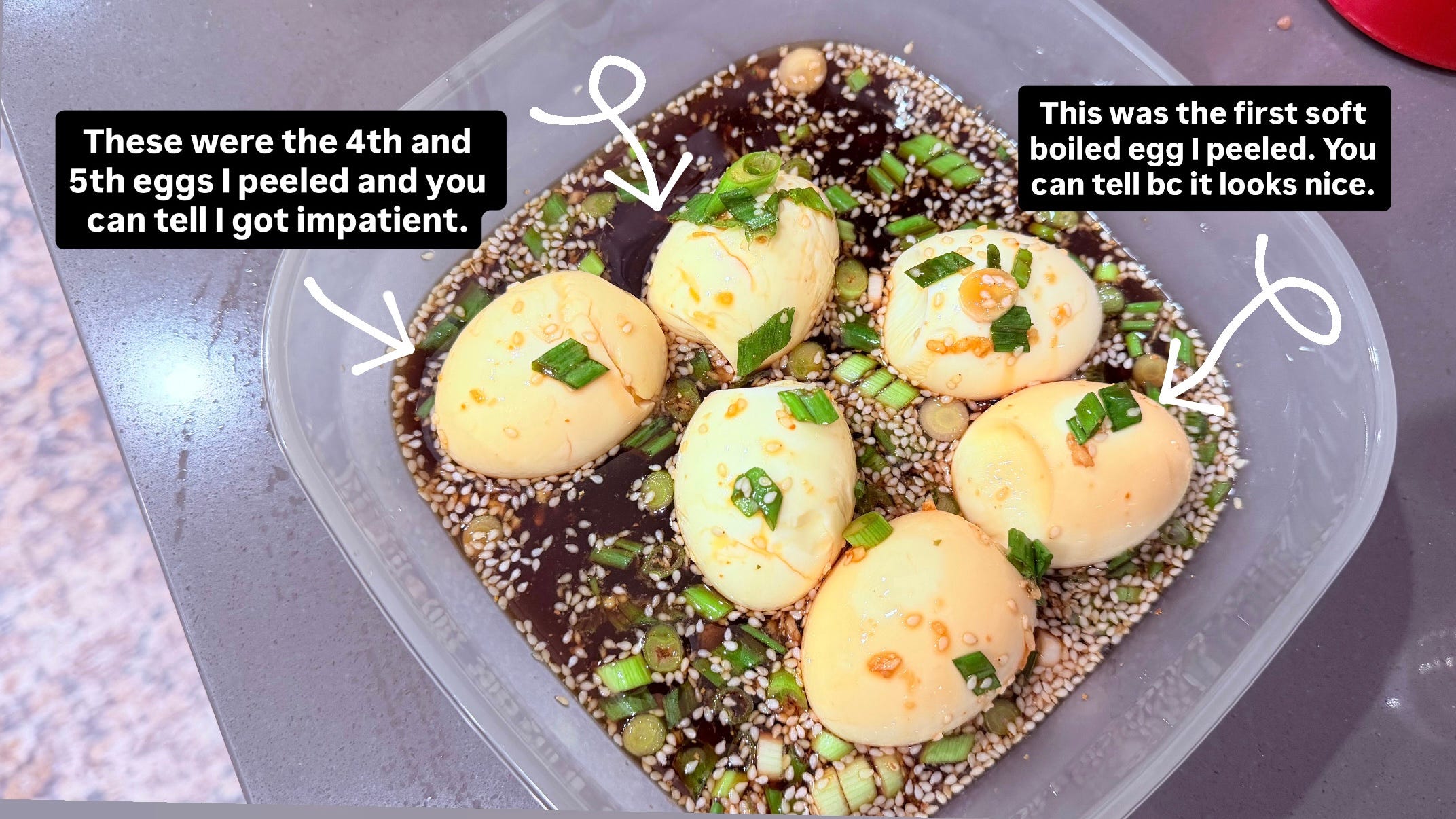
🥚 I’m making Mayak Eggs, or Korean marinated eggs, this week. I’ve never made them before but I love rice and eggs so I have no doubt they’ll become my new obsession. Have you made them before? I’m using Cookerru’s recipe. Send me your fave recipe!
See ya next week, cuties.
ah yes! We have Kaleigh