
The Channels Getting Credit Aren't the Ones Doing the Work
Why marketers should care more about measurement and less about attribution

Raise your hand if you have ever been personally victimized by a CRM.
Good.
Well, no, actually, that’s not good. But we’ve all been there. The Salesforce dashboard, the weird Google Sheet that first marketing hire on your team made, they all told slightly different stories about marketing ROI, and everyone had a different opinion about which one was actually right. And I bet you that each person and each source of truth was pretty right… and they were pretty wrong, too.
When you think about time spent chasing numbers, learning the marketing dashboard du jour, and the literal budget spent on the software, the task of figuring out the ROI of each marketing campaign becomes the most expensive task for the marketing team. That chaos usually comes from one core confusion: treating attribution and measurement as if they’re the same thing. But in actuality, attribution tries to assign credit, and measurement tries to understand impact. Those are fundamentally different jobs. And that’s what I break down on today’s 11-minute episode of the Zero Click Marketing podcast.

Attribution is about capture — it rewards the channel that happened to be standing at the finish line when a buyer converted. Measurement, done well, is about lift. Did this create awareness? Did it increase branded search? Did it make the pipeline move faster? Did it change behavior beyond what would have happened anyway?
If you’re only doing the first job, you’re not really measuring your marketing. You’re just watching the finish line.
The 76% Problem
Over on the SparkToro blog, Rand Fishkin’s recent research on the 5,000 most-visited websites puts hard numbers on something a lot of us have sensed but couldn’t prove. Search accounts for about 24% of all visits to those sites. The other ~76% is spread across social media, news, email, entertainment, forums, e-commerce, and hundreds of other destinations. That’s where attention lives. That’s where opinions form. That’s where someone first hears a brand name, sees it mentioned in a newsletter, has a colleague drop it in Slack — and starts building the low-level familiarity that eventually leads them to Google.
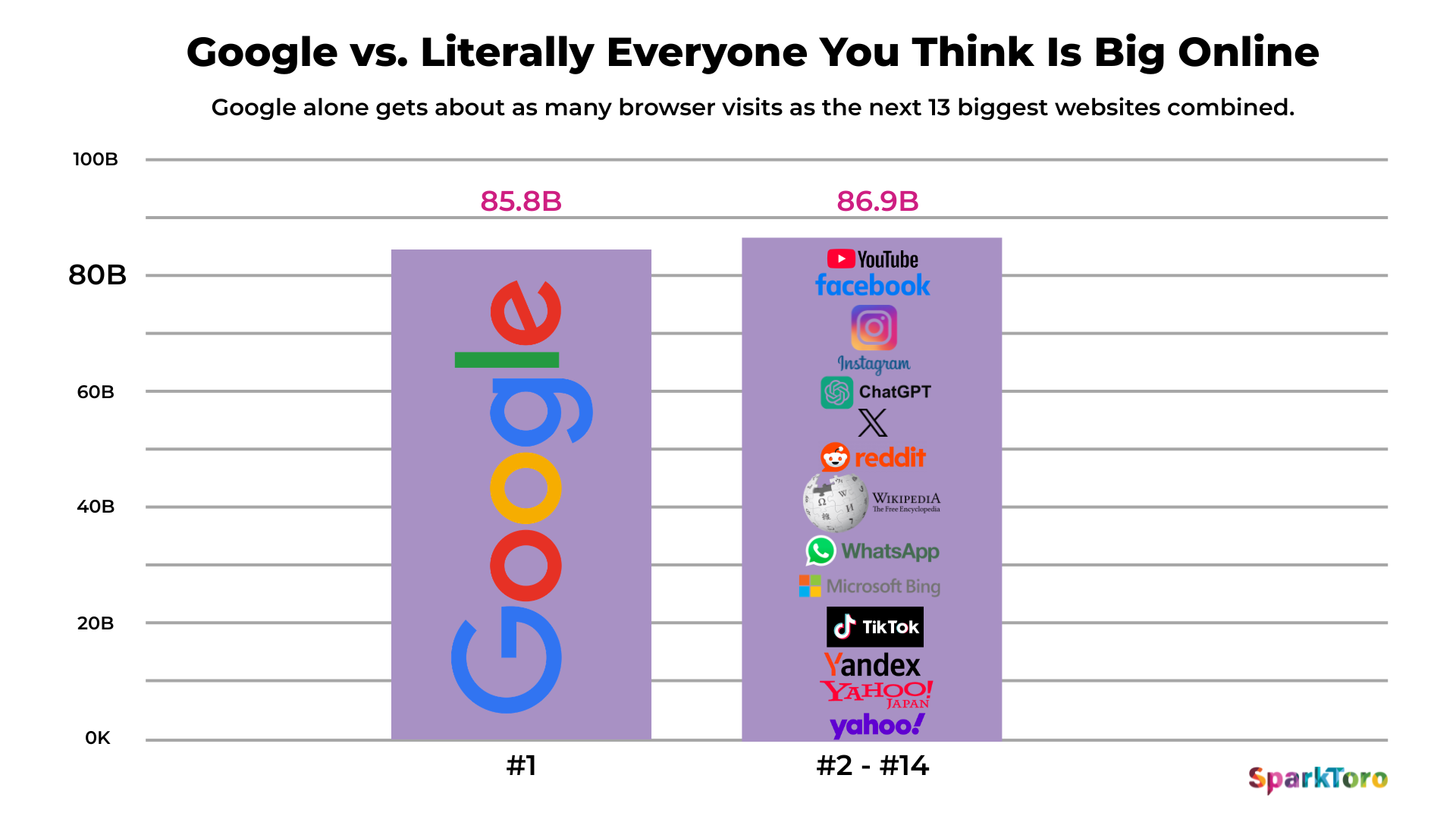
Google is so dominant it receives more visits than the next 13 largest websites combined. But that’s kind of the point: search is concentrated. Influence is fragmented.
And so what happens, over and over again, in buying journeys everywhere is this:
Someone sees a LinkedIn post mentioning a tool. They read a newsletter where the same brand comes up. A colleague sends an article where it’s referenced again. Then they search the brand name on Google, click the first result, and sign up for a free trial.
What does your attribution dashboard see? A search visit that converted. SEO gets the credit. Maybe SEM, if there’s a paid result in the mix. The LinkedIn post, the newsletter, and the Slack message — the three moments that actually created the demand — don’t even show up. They’re in the invisible 76%.
(If you want to go deeper on what’s actually happening in that invisible 76% — including new research from Ross Simmonds on Reddit’s grip on B2B SaaS search, and Wil Reynolds’s experiment on how one old negative review kept showing up in AI brand outputs — last week’s Zero Click Marketing episode covers all of it).
This is the core flaw. Attribution systems are designed to measure demand capture. If all you need to know is which channel was the last thing someone touched before they bought, attribution can tell you that with real precision. And multi-touch attribution makes it even muddier. If Meta and Google are both in the mix, now you just have two platforms arguing over who gets credit — neither of which is the LinkedIn post, Substack newsletter, or the Slack message that actually started the whole thing.
Every time a CMO pulls budget from brand marketing or organic social to put more into Google Ads because “the numbers say search converts better,” they’re defunding the activities that made search work in the first place. (If YouTube is your jam, then you can listen to this podcast episode below.)
What Measurement Actually Looks Like
The fix isn’t a better dashboard. Another layer of attribution sophistication is not going to reveal causality. You’re still going to need experiments. You’re still going to need to look for directional lift.
What you can do is ask better questions. Instead of “which channel gets the credit?”, try:
Are more people searching for us by name? Are prospects mentioning us earlier in sales conversations? Are we seeing lifts in direct traffic or branded demand after sustained visibility efforts? Are conversion rates improving among people who already recognize our brand? Are we more remembered, more preferred, more sought out?
Those are measurement questions. And they’re much closer to how marketing actually works. When Zero Click Marketing is working — when you’re showing up in the right feeds, earning mentions, getting quoted, building genuine familiarity — your paid channels get better too. CPAs go down. CTRs go up. Conversion rates improve. And it’s all because people are arriving already warmed up. Rather than the ad introducing them to a stranger, it’s reminding them of someone they’ve already met.
That’s not a soft, hand-wavy brand argument. That’s the efficiency argument. And I’d bet that your performance marketing colleague (or if that’s you, hi!) would agree. It’s just that people who are “warmed up” are a lot harder to assign a lead score to.
Attribution still has a role. I’m not saying throw it out. But if you treat it as the whole story, you’ll keep starving the parts of marketing that create demand in the first place.
Measure lift. Not just capture.
And on that note about influence being everywhere… next week on Zero Click Marketing podcast: the public record — how to influence it so that your best self can show up in AI answers and the Google snippets before a buyer ever clicks.
🧁 Petits Fours: Managing Up; Skincare; Company Retreat
💼 Advice on managing up that people will hate: I saw this Threads post about people management at large companies. Basically, if you complain about your manager, you’re likely to get labeled as the problem simply because it’s easier. Either they think you’re being over sensitive and they hope you’ll eventually quit. Or they believe you but addressing your problematic manager is more work — they’d have to manage them out, hire someone new, and onboard them. That’s expensive. This is obviously really shitty, and if you’ve ever worked at a company with more than 100 people, you know it’s totally true. But I’m not an executive at a big company nor am I your skip-level boss, so I can’t really help the problem. However, I am pretty good at corporate politics, so I can help you. If you have a shitty colleague, don’t complain about them. Describe the pattern, name the impact, quickly reveal your current solution, and make a specific request to unblock the obstacle. Example: “Hi, Skip-Level Boss. I value our every-other-month check-in. I’d love your advice on how to make our feedback process more efficient. I’ve noticed that feedback sometimes comes in pretty late in the cycle, and when that happens I’m not always clear on the top priority changes versus nice-to-haves. I’m trying to mitigate that by sharing drafts earlier and summarizing decisions in writing, but I’d love your perspective on how you’d streamline this.”
People managers love “value,” “process, and “empowering” people, and they really love when you “love” being open-minded to their ideas.
Why am I telling you this? Because you’re one of my newsletter readers, I assume you’re a pretty cool person, and I trust you will use this power for good.
🧴 Skincare advice: Absolutely nobody asked. But I’ve simplified my skincare routine, my skin looks so much better now, and I want to tell the world. Every night I wash my face with an oil-based cleanser. Then every other night, prescription tretinoin. Medik8 Advanced Night Ceramide on top, every night. In the mornings, I rinse my face, apply vitamin C serum, peptide serum, and Vanicream Daily Facial Moisturizer. Sunscreen on top if I’m going out. No more exfoliants, no more face masks, and no more 7-step routine. I’ll still use a sheet mask when I’m traveling, though.
📺 Lisa Gilroy on “Jury Duty Presents: Company Retreat” is hilarious: Please tell me you’re watching Company Retreat. BUT DON’T SPOIL IT FOR ME because I haven’t finished it yet. Anyway. Actress/improv superstar named Lisa Gilroy is the funniest person I’ve seen in years. I’ve rewatched this scene at least 5 times already and each time, I find something new to laugh about. (Well, to be clear, that’s only a small snippet of the full scene. It’s worth watching the show just for that.)
🧹 Because I need a fourth thing or else it’s not really Petits Fours: I don’t know who needs to hear this, but you need to clean your desk. Declutter, throw away trash, and wipe down that desk. It’s covered in your Hot Cheeto dust. (It’s me, I’m the one who had the Hot Cheeto dust.)